Humpty Dumpty Bulldozed
Stop at Flag 10. You are right on the edge of the sinkhole pond. In front of you is a jumble of mammoth bones. Up by Flag 10 is a mammoth skull where the top edge of the tusk is flat. The original bulldozer first scraped this tusk in 1974 but it was not fully uncovered and excavated until 1983. It was not until that year did the researchers begin to fully realize the wealth of mammoth skeletons below and around that scraped tusk.
Bone Jumble

Now look down to your right. Another skull with highly-curved tusks, a nearby lower jaw, a shoulder blade, and a number of leg bones are showing. These bones represent carcasses that settled to the bottom of the pond right along the ledge of the sinkhole. Head further along the pathway and around the fence.
Calm Water

Imagine if you were here 140,000 years ago. Looking west as you are, the edge of the sinkhole had lots of vegetation rimming the pond, which was likely
90-95°F (32- 35°C). The water and vegetation surely enticed herbivores to enter the sinkhole. The calm water might not have looked all that deep here – this end was shallow but it quickly dropped to some 60 ft. deep. Researchers feel that it is this west end of the sinkhole where the mammoths entered the pond.
Murray

Now look down into the excavation pit where all the skeletons are located. Flag 11 is a Columbian mammoth skeleton that we have named ‘Murray.’ Look closely…it is an almost entire articulated skeleton (meaning all in life position) but
it is missing its head. The skull should have been right where Flag 11 is positioned. Which of the 6 nearby skulls is Murray’s? We just do not know. Observe that Murray is resting on his left side so you are looking at his right side. That big flat shield-like bone near Flag 11 is Murray’s right shoulder blade.
When this skeleton was first discovered to be headless, it was named ‘Marie Antoinette’ after the French beheaded queen. However, once the pelvis bones were exposed and examined the gender revealed it was a male.
Bear Down
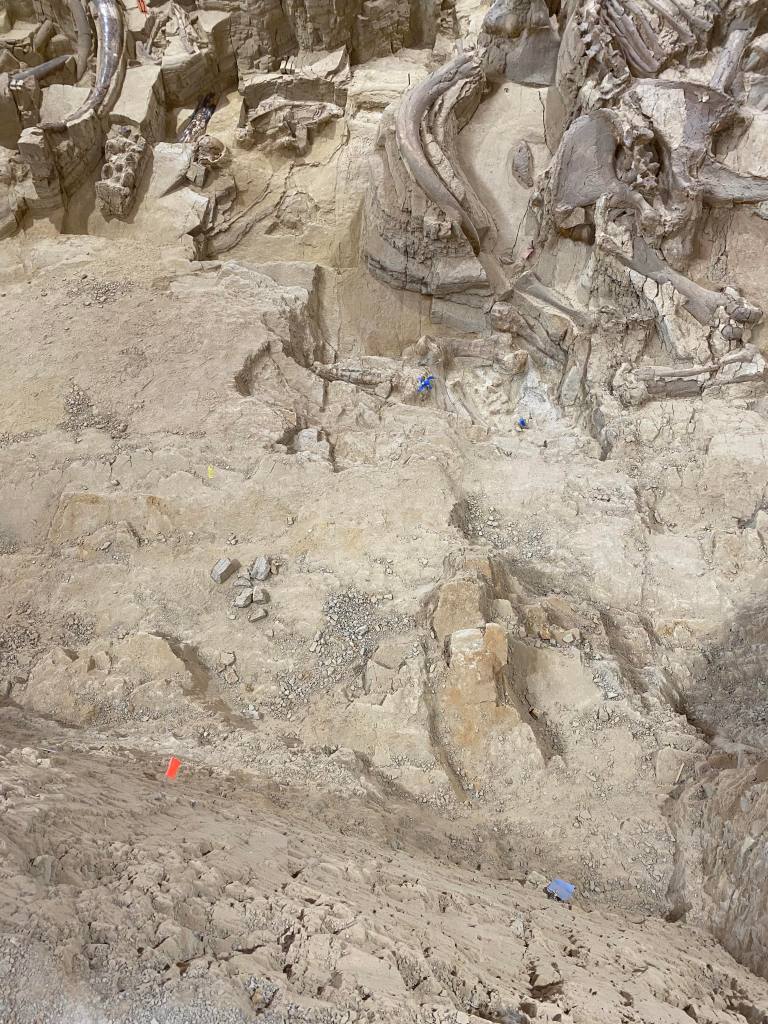
The center of the pit locates the approximate position of the skull of the extinct giant short-faced bear that was recovered in 1983. The skull is currently kept in collections so it can be studied by researchers. Whether this bear met its match with a not-so-dead mammoth or just became entrapped in the sinkhole, this skeleton divulges to scientists that this largest of bears once roamed the Black Hills during the Ice Age. A full-grown adult male giant short-faced bear standing on four legs would have been able to look someone 5 ft. 10 in (2 m) directly in the eye. When the bear stood up on its hind legs, the claws could have reached as high as 15 ft. (5m). This is tall enough to touch the shoulder of a Columbian mammoth. In modern terms, the bear could look into a second-story window. Now turn around and head further along the pathway passing the stairs to the overlook.
 The Mammoth Site