
Inside the Western Edge
Tusk, Tusk, Tusk
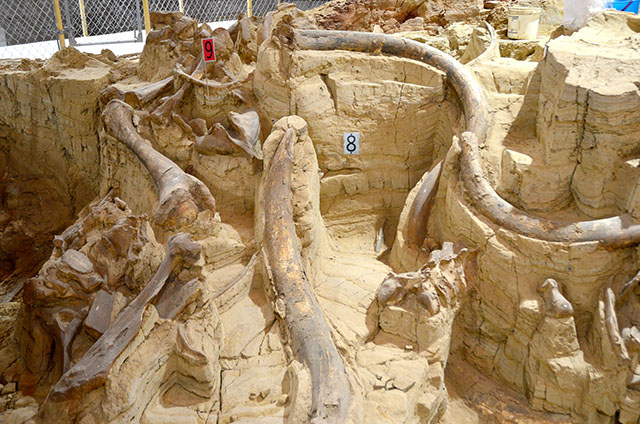
You are now at the far western edge of the sinkhole but still on the inside. Take a look at the number of isolated tusks in the area immediately below where you are standing. Realize that tusks are ever-growing teeth and are only loosely connected into the socket of a skull. Because of this, they can easily slide out of the socket while the carcass is decomposing. There are no tusks in the lower jaw of elephants and mammoths but some distant relatives have tusks in both upper and lower jaws. Thus far there are 122 tusks recovered in the sinkhole and knowing that each individual had only two tusks when it died, a minimum of 61 mammoths are currently exposed. Only two mammoths have been identified as the smaller woolly mammoth.
Just Jawing
Note the number of lower jaws in this same area. Look down to the lower jaw below Flag 9. All mammoths and elephants have flat, grinding teeth made up of a number of vertically-aligned plates cemented together. As these plates erode through chewing, they become the ideal shears for grinding up grasses and sedges which paleontologist determined made up the majority of their diet.

Deep Dip
Look to your right across the excavation area to the far wall. Take notice of the angle of the sediment beds … they are at first horizontal to your left and then dip steeply to the east toward the middle of the sinkhole creating a sharp drop. This area with more-or-less horizontal layers could have been where the mammoths entered the sinkhole only to find that they could not get out here and that the pond became dangerously deeper to the east. As you continue to move up the tour pathway, note that you are now walking out of the sinkhole, you just went over the red Spearfish shale pond rim. Although other better climbing animals probably were able to clamber out, mammoths just could not do it. This sinkhole was truly a mammoth-selective trap. Eighty-five different species of life have been identified at The Mammoth Site thus far. Some of the mammals found here include the coyote (Canis latrans), pronghorn (Antilocapra americana), Yesterday’s camel (Camelops), giant short-faced bear (Arctodus simus), extinct species of llama (Hemiauchenia) and many other smaller animals. Most of these animals probably died around the outside edge of the pond and their remains were periodically washed into the sinkhole. Collectively, the assemblage of animals found here indicates a regional environment characterized by grasslands and open woodland or forest. Continue walking up the pathway.

 The Mammoth Site