
Tibs and Fibs
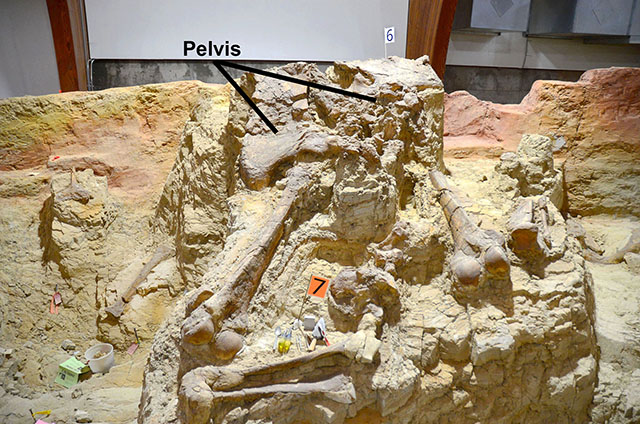
At Flag 6 you are looking at the lower half of a mammoth skeleton. Although highly modified by the action of freeze-thaw over the millennia (bones are highly fractured), notice the two fanshaped blades of the hip bone (as you saw at Flag 2). Below each blade is the upper leg bone (femur), the knee cap, the lower legs (both the tibia and fibula), and various bones of the feet. Upon his death, this mammoth became lodged belly to the wall. Either the upper half of the carcass was preserved and then eroded away before researchers could excavate it, or, only this part of the decaying carcass settled in this section of the pond to become buried.
Trowels and Brushes
The tools you see at Flag 7 are the typical instruments that paleontologists use when working on the details of excavation. The Hollywood version of paleontologists walking along the ground and finding a fully articulated, unbroken skeleton is truly rare. Shovels, picks, and hoes are not used as they may harm the bones at the point of discovery. It is a delicate job to remove just the sediments, leaving behind the bone on a sedimentary pedestal for support. Sediments that are removed from around the big mammoth bones are not just tossed away. They are bagged and then wet screened through a fine-mesh sieve to recover the smaller bones of fish, frogs, and rodents. Sounds fun? If you are interested in the potential of participating in an excavation, see a staff member at the front desk for more information. The crew that you may see excavating within the sinkhole are either staff researchers, Ice Age Explorer Program participants, or Interns. There is something for almost all ages.

No Articulation Here
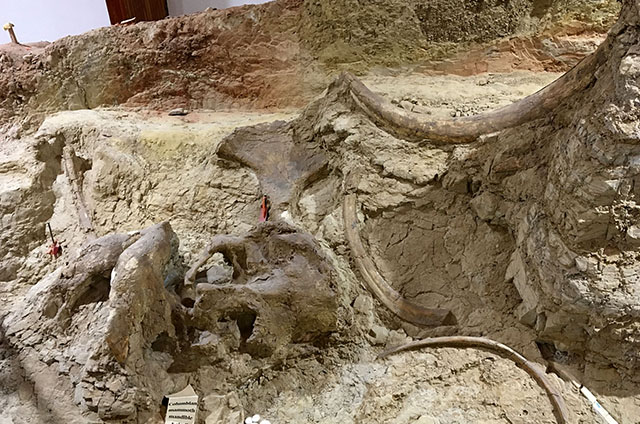
Take a look down to your left from Flag 7 and you will see another Columbian mammoth skull, maybe its lower jaw right next to it (upside down), another half pelvis nearby towards the wall, and a huge, long tusk above. Unless the jaw is articulated with the skull, there is only an assumption that the jaw is part of this skull. Interestingly, at this depth within the pond, researchers find many mammoth skeletal remains littering the edge of the sinkhole.
Now turn around to look at the opposite wall behind you. Take a close look at the hundreds of layers of sediments. Again, because these are so nicely divided into distinct layers, this indicates that the water in this pond was still, no real current at all…just a quiet pond of warm water filling in with sediments and unfortunate mammoths. Continue up the ramp to Station 5 and look for Flags 8 and 9.
 The Mammoth Site