The Vertical Wall
Skulls
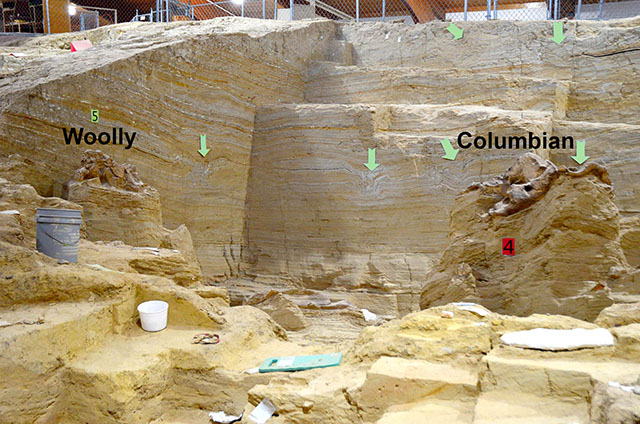
The Mammoth Site sinkhole pond that you are now standing on the edge of contains skeletal remains that researchers feel belong to both Columbian and woolly mammoths. In front of you are two upside down skulls. Slightly to your right is a skull next to Flag 4. This is a Columbian mammoth with its molars oriented up and the tusk sockets pointing to the right. Further to your left against the wall is a woolly mammoth skull below Flag 5. Mammoths typically would have 4 sets of teeth in their mouth at any one time. Each tooth row would have up to 6 teeth through the course of their life. At the Overlook you will have another view of these two skulls. Although the common dinosaur bone and these mammoth bones are all fossils, The Mammoth Site bones have not had mineral replacement of the organic material and are not petrified. Instead, the warm water of the pond leached out all the organic material, leaving behind a mere fragile skeletal remnant. Because of this, a plastic preservative solution has to be soaked into the bones to conserve them for view and study.
Fossil Footprints
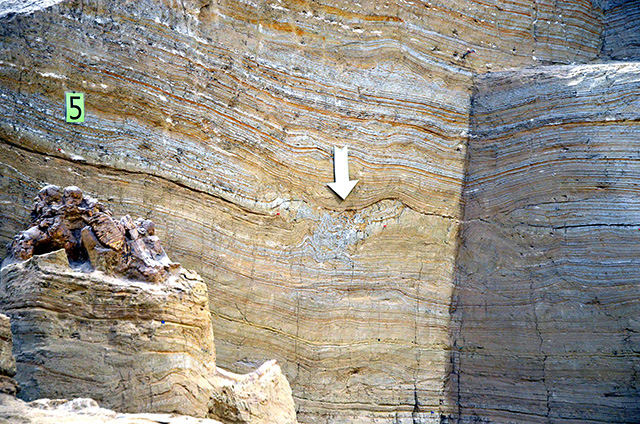
Now look straight across, between the two skulls to the wall. First notice the multiple layers of sediments; these are all nicely divided into distinct fairly horizontal layers. This indicates the water was not turbulent or fast flowing while the sediments were being deposited. Notice the big green arrows on the wall. Research indicates that the curved, irregularities of the sediment layers could be caused by feet such as stepping in mud – and based on the size of these depressions, were likely made by the mammoths. Apparently by this time of sediment infilling, the sinkhole mud and the water was at a depth that a swimming mammoth would just be able to touch the bottom of the pond and their foot prints were recorded in the soft mud. Imagine stepping in mud, your foot sinking down, and as you pull your foot back up, the muck sucks at your foot and distorts the ground below. Your view here of the footprints is in profile, a cross-section.
Slippery Shale
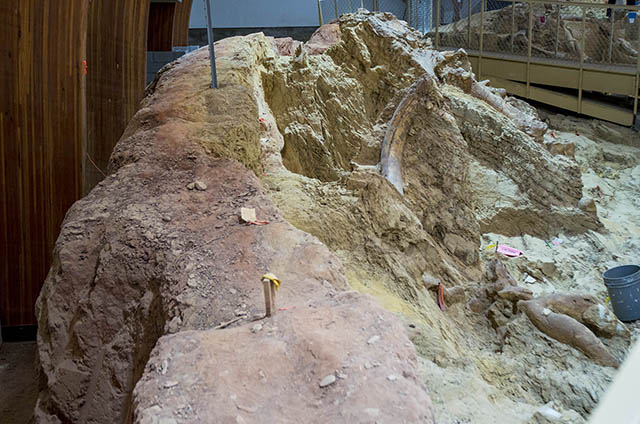
Proceed up the ramp on your left towards Flag 6 and 7 at Stop 4. You have crossed over the red, oxidized iron-rich Spearfish shale that is the border of the sinkhole – you are now standing inside the ancient pond. Looking to the left, note the wall of the Spearfish shale is fairly vertical on the interior. When shale is wet it becomes a slippery, muddy, clay-like substance. This would be very difficult, if not impossible, spot for any animal, including those with claws or fingers, to climb out of the pond. Remember the top of the sinkhole was about 25 ft. above you during the Ice Age – it has since eroded.
 The Mammoth Site