
25 Feet Underwater
Deep Water
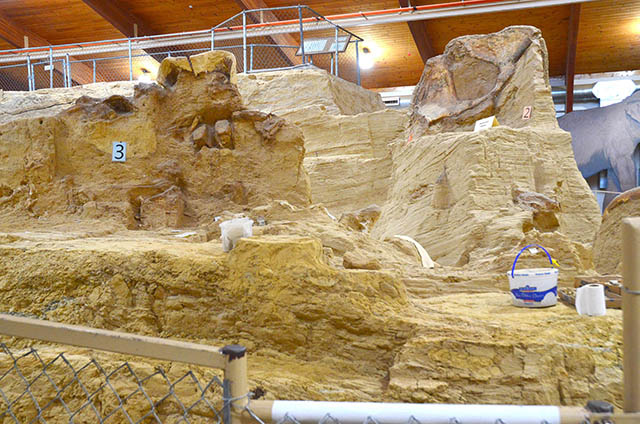
As you stand at this location, you are poised at the excavated edge of the sinkhole. While looking up to the right at the pelvis at Flag 2, take a step back in time. If the pond was active, you would be at least 25 feet (7.6 m) underwater! Scientists estimate that the top of the sinkhole 140,000 years ago would be equal to about the rafters of the building you are in now.
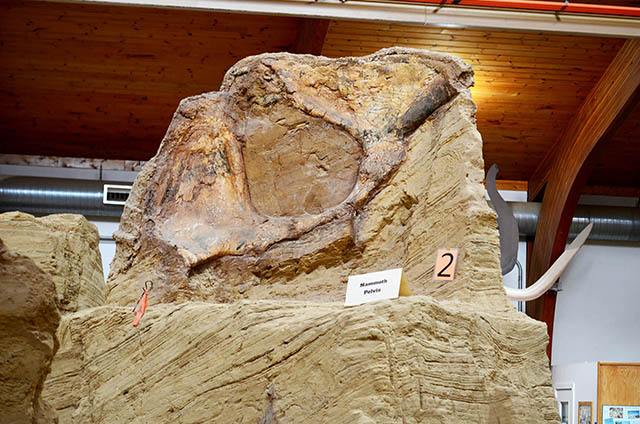
Pelvis
The large butterfly-shaped bone at Flag 2 is a complete pelvis bone (both blades equal to our hip bone). Paleontologists have found that one can measure the pelvis to determine the gender of the animal (male or female). Thus far researchers at the site have found that all the complete hip bones of mammoths in the sinkhole are male. At first this may seem odd to you but when you look into the social structure of both types of living elephants (Asian and African), all-male herds are created when adolescent males are forced out of the main group by the principal female. The sinkhole skeletons may be recording an Ice Age all- male herd of mammoths. As the decomposing mammoths sank to the bottom of the pond, sediments slowly settled in and around them. Below and around the pelvis you can see layer upon layer of sands, silts, and clay that have encased the bone. These nicely layered sediments indicate no churning or strong currents occurred in the water at this depth.
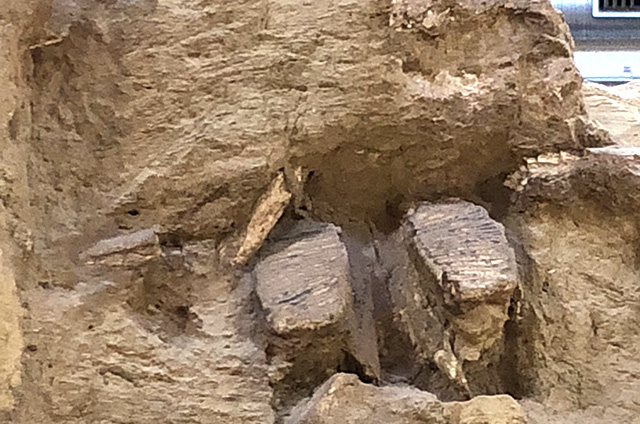
Teeth
Looking at Flag 3 you will see a pair of oval-shaped objects with their flat surfaces characterized by a series of ridges. What you are looking at is the flat chewing surface of two upper molars from a Columbian mammoth. These teeth provide information on the individual age of the mammoth, distinguish between Woolly and Columbian mammoths, and help scientists reconstruct their diet. The teeth of this fossil specimen currently puts its age at approximately 38 years old. Ready to go on? Head further up the ramp to Station 3 and look for Flags 4 and 5.
 The Mammoth Site