
On the Edge of the Sinkhole
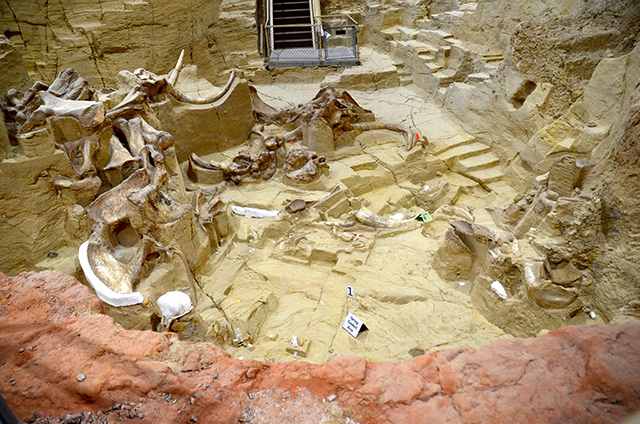
You are now standing on the edge of the sinkhole noticeable by the rim of the red Spearfish shale. 140,000 years ago, the sinkhole was filled with warm water. The majority of plant remains recovered from the sinkhole indicate a tree and grassland environment: a variety of grasses, hackberry (Celtis), and sedges (Carex), with small areas of scattered oak (Quercus), willow (Salix) and pine (Pinus). The sinkhole pond likely offered an attractive water and food source for the local fauna. Unfortunately, the edge of the sinkhole being lined with red Spearfish shale made the sides of the pond very slippery. When the mammoths were enticed into the pond they soon found that the combination of the slippery shale and the steep angle of the pond edge fatally entrapped them.
In the Beginning
Look across the sinkhole in front of you to the two life-sized cutouts of mammoths. Above the Woolly mammoth on the left you will see two green arrows on the beam of the building. Follow the arrows direction up the beam to an orange ball hanging from the ceiling. This is the original exposure of the first mammoth find by land-developer Phil Anderson. This is one of two locations that Drs. Larry Agenbroad and Jim Mead verified the mammoth discovery in 1974 and The Mammoth Site’s future was sealed. Since 1976 approximately 25 feet (7.6 m) of the deposit has been excavated. The sediments that washed into the sinkhole and covered the mammoth remains were compacted and partially cemented, making them more resistant to weathering and erosion than the surrounding Spearfish shale. As a result, the sediments surrounding the sinkhole eroded away over time and the sinkhole was left as a hill.

Spring Conduit
In the lower position of the excavated sinkhole, the marker Flag 1 marks the actual center of the spring conduit where warm water slowly emerged into the sinkhole to create a deceivingly-friendly pond. Ground water moving through the lower porous limestone eroded away the limestone forming a large cavern. As the cavern grew, the weight of the sediment layers above eventually collapsed the roof of the cavern, forming a bowl-shaped depression called a sinkhole. The collapsed roof opened cracks, allowing the spring water to bubble up into the sinkhole, creating a small pond environment. In 1976 three core samples were taken of the sediments which showed that the sinkhole contains at least 67 ft (20.4 m) of layered sands, clays, and mammoth bones. In the earlier days of the excavations, researchers removed fossils from the area designated by Flag 1. In the early 1980s scientists temporarily ceased excavation to protect the site and to construct the building that you are now standing in. Now head up the ramp on your left up to the Flag 2 stop.

 The Mammoth Site